
“The atypical and almost clandestine artistic trajectory of Juliette Roche, which, having been shaped through direct contact with successive avant-gardes, never ceased to remain eminently personal.”
Juliette Roche (1884-1980), french painter and writer.
Juliette Roche frequented the Parisian artistic scene from an early age, thanks to her godmother, Countess Greffulhe, and her father’s godson, Jean Cocteau. Supported by her father, Jules Roche, an important politician, she studied painting at the Académie Ranson.
Adopted early on by the Nabis group, she discovered Cubism in 1912, decided to break up with Félix Vallotton and Maurice Denis. In 1913, she exhibited at the Salon des indépendants and wrote poems.
Her first solo exhibition took place at the Bernheim-Jeune gallery in 1914. When war was declared, the artist and her future husband, the cubist Albert Gleizes were convinced pacifists and headed for New York, where Marcel Duchamp introduced them to the circle of collectors led by Louis and Walter Arensberg.
From 1915, she participated in Dada activities with Duchamp and Francis Picabia. After a long stay in Barcelona, the Gleizes couple, who were exhibiting at Galerie Dalmau, returned to New York. Juliette Roche collaborated with Marcel Duchamp in preparing the first exhibition of the Society of Independent Artists (April 1917), where she presented a number of Dadaist-inspired works. She worked on the «second degree», in Nature morte au hachoir, the object reflects a decentered image of the war
In 1919, back in Paris, she began writing La Minéralisation de Dudley Craving Mac Adam, published in 1924 and evoking the adventures of Arthur Cravan and the exiles in New York.
In 1921, her poetry, État... colloïdal, appeared in Creación, Vincente Huidrobro’s periodical.
In 1927, together with Albert Gleizes, they founded the Moly-Sabata artists’ residence in Sablons (first ever artist residency), which provided handicraft workshops and brought together, among others, Anne Dangar (1885-1951). At the time, Roche was a fervent supporter of popular art education.
A major retrospective exhibition was held in 1962 at the Galerie Miroir in Montpellier, but it was not until the 1990s that her role in the Dada movement was reconsidered.
In 2022 and 2023 numerous paintings entered important public collections such as Orsay Museum Paris or Centre Pompidou Musée National d’Art Moderne. The Albert Gleizes Foundation has chosen Pauline Pavec Gallery to take over the Estate of Juliette Roche.
Catherine Gonnard
Excerpt from the The Universal Dictionary of Creatives
© 2013 Des femmes – Antoinette Fouque
Collections Publiques
International
USA, Los Angeles County Museum of Art, LACMA
Belgium Antwerp, The Royal Museum of Fine Arts, KMSKA
France
Paris, Musée Carnavalet, France
Paris, Musée national d’art moderne, Centre Pompidou, France
Paris, CNAP, France
Besançon, Musée d’art et d’Archéologie, France
Blérancourt, Musée franco-américain, France
Céret, musée d’art moderne, France
Les Sables d’Olonne, MASC, Musée d’art moderne et contemporain, France
Lyon, Musée des Beaux-Arts, France
Montpellier, Musée Fabre, France
Pont-Aven, Musée, France
Rennes, Musée des Beaux-Arts, France
Roubaix, Musée La Piscine, France
Rouen, Musée des Beaux-Arts, France
Saint-Germain-en-Laye, musée Maurice Denis, France
Saint-Rémy-de-Provence, Musée Estrine, France
Thonon-les-Bains, Musée du Chablais, France
Valence, Musée des Beaux-Arts, France
Mougins, FAMM, France
Fondation des Artistes, France
-
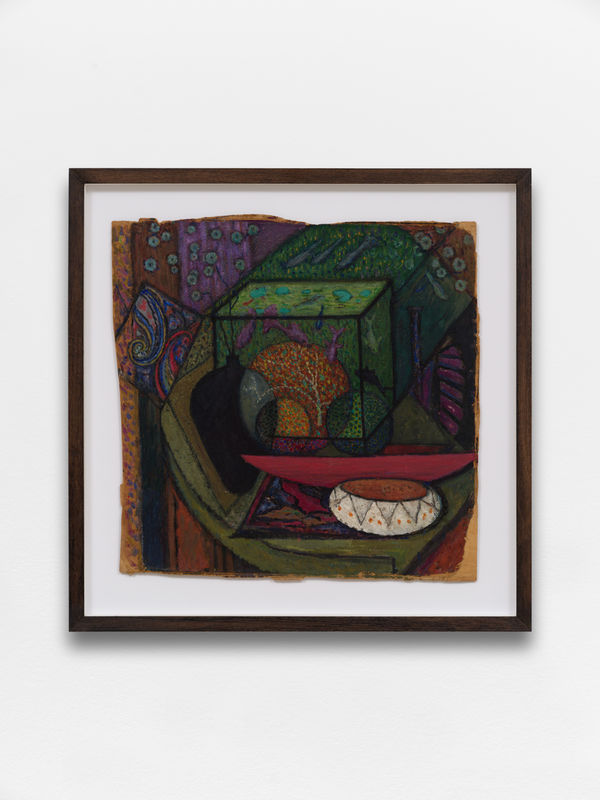
 Aquarium, c. 1917-1918
 -
Fleurs dans un vase, c. 1918-1920

-
ON AIME TROP DE CHOSES DIFFÉRENTES
FLORA MOSCOVICI | JULIETTE ROCHE 5 - 28 Feb 2026From February 5 to 28, 2026, Pavec presents an exhibition bringing together Juliette Roche (1884–1980) and Flora Moscovici (1985–), two artists from different generations placed in dialogue around color and...Read more -
LES DÉSERTEURS
BAS JAN ADER | MARIE BRACQUEMOND | GUSTAVE COURBET | SALVADOR DALÍ | QUENTIN DEROUET | SIMON HANTAÏ | VICTOR HUGO | JACQUELINE LAMBA | ROBERT MALAVAL | FLORA MOSCOVICI | OLIVIER MOSSET | GEORGES RIBEMONT-DESSAIGNES | JULIETTE ROCHE | MATHILDE ROSIER 5 Dec 2024 - 11 Jan 2025BAS JAN ADER | MARIE BRACQUEMOND | GUSTAVE COURBET | SALVADOR DALÍ | QUENTIN DEROUET | SIMON HANTAÏ | VICTOR HUGO | JACQUELINE LAMBA | GHERASIM LUCA | ROBERT MALAVAL...Read more -
LE PAS DE CÔTÉ DES AVANT-GARDES
JULIETTE ROCHE 1 Feb - 13 Apr 2024The opening exhibition of the new space of the Galerie Pauline Pavec is a solo show featuring the works of historic artist Juliette Roche. This retrospective exhibition aims to promote...Read more


A FEMININE NABIS?
Trained by obscure academic masters, Edmond Borchard and then Charles-Frédéric Lauth, both former students of Alexandre Cabanel, Juliette Roche is nevertheless drawn to more advanced artistic trends. Her initial submissions to Parisian Salons in 1906 are not aimed at the French Artists or the National Society of Fine Arts, as one might expect, but rather at the Independents, where the first avant-gardes of the 20th century freely express themselves. Instead of aligning herself with the Fauves, her contemporaries who had emerged brilliantly the previous year, Juliette Roche turns to older artists, the Nabis, whose initial manifestations date back to the 1880s. Among the members of this group, the one she clearly looks up to, more than Maurice Denis, Paul Sérusier, or Édouard Vuillard, is Paul Vallotton, with whom she shares, at least initially, a taste for formal synthesis and certain iconographic oddities.
Evidence of Juliette Roche's adoption of the theme of public gardens proves her reverence for Nabi art, even though she soon begins to express her discordant voice. Her stifling urban gardens, apparently reserved for women, reveal an already assertive personality. The flattened perspective, thick almost lumpy brushstrokes, and acidic colors distinguish them, along with the caricatural traits of certain figures. Indeed, in her paintings from this period, Roche seems torn between her loyalty to Nabi aesthetics and naturalistic or even expressionistic tendencies evident in some of her early works. In choosing her subjects, which almost all belong to public spaces, she also explores spheres of activity far from the serene family representations that the Nabis specialized in. Small businesses, new sports practices, the upscale leisure of her social class, as well as the sometimes unsettling world of entertainment, such as cabarets with ambiguous clienteles, inspire compositions that extend beyond the capital. Curious about the lives of ordinary people, Roche also describes, in darkened colors, the recently urbanized peasantry of Ardèche, to which she is personally attached.
Juliette Roche's Paris is not only that of the upscale neighborhoods (Champs-Elysées, Place Victor-Hugo, Esplanade des Invalides) but also that of more popular districts like the slopes of Montmartre where, escaping her own milieu, she explores the margins of society. Discreetly subversive, the two compositions set on Rue Victor-Massé are significant enough to have been the subject of several drawn or painted studies. They depict ethnic (Roche is an overlooked pioneer in the representation of Black people at this time) and sexual minorities, such as a couple of women visiting a mask shop. A close friend of Jean Cocteau, whose portrait she never completed, and whose notorious homosexuality did not dismay her, Juliette Roche is also the author of intimate drawings leaving little doubt about her attraction to the sapphic theme, a tendency that her American years would only confirm.
"I WILL NEVER BE A CUBIST"
When Riccitto Canudo, the director of the "celebrity art gazette" Montjoie!, introduces Juliette Roche to Albert Gleizes, a prominent figure in Cubism in 1913, she is far from discovering this innovative movement. Revealed to the Parisian public at the 1911 Independents, Cubism – at least "Salon Cubism" – has been on everyone's minds for two years. Intrigued by this new movement, Roche continues her figurative production, showcasing a wide range of her work at Bernheim-Jeune in spring 1914. It is only during her stay in Barcelona two years later, accompanied by her now-husband, that Cubist influences begin to appear in her work. While a Spanish Dancer owes much to Gleizes' paintings of the same period (exhibited at the Dalmau Gallery in December 1916), Roche quickly distinguishes herself by rejecting the Cubist orthodoxy advocated by her husband. In her series dedicated to the Ramblas of Barcelona, some adopt the frieze-like composition of Egyptian bas-reliefs; she sparingly employs the prism-like decompositions favored by Cubists and sticks to simple geometric shapes. This sequence seems to conclude with figures of exaggerated realism, where Cubism plays an even smaller role. Formally composite, her two still lifes with a porrón confirm Roche's occasional use of Cubist vocabulary. In the version at the Museum of Fine Arts in Lyon, contrasting with the background of interlocking planes, the Catalan vessel and the foreground vase, one flat, the other modeled, are exempt from any geometric stylization. In this painting, as later with her Acrobats, the appearance of colored discs undoubtedly betrays the diffuse influence of Robert and Sonia Delaunay, who, during their Portuguese period, made extensive use of them.
Upon the Gleizes' return to New York, Cubism had become one component among others of Juliette Roche's style. She uses it to compartmentalize the space of a Brooklyn hotel pool, suggesting the successive and truly breathtaking visions of a diver leaping from a diving board. Inspired by the syncopated rhythms of jazz, which she encountered upon arriving in the American metropolis, her Dancer Couples offer an eclectic version of Cubism, where shattered forms, including skyscrapers, are covered with obsessive decorative motifs. For The Chopper, her only pictorial contribution to the Dada scene, she recalls less Marcel Duchamp's Coffee Mill painted in 1911 (London, Tate) than she parodies the recent mechanographic compositions of Francis Picabia, using metallic pigments like him. The somewhat awkward placement of a small collage of newspaper clippings, transforming this representation of an everyday object into a pacifist plea, betrays an underestimation of the artistic potential of collages, at least as their inventors, Braque and Picasso, had experimented with them since 1912.
However, there is no trace of Cubism in her emblematic American Picnic with its supple forms and vibrant colors. Already employed in her representations of puppet-like dancers or acrobats tossing rings, the stylization of the bodies is spectacular, reaching its peak with two merging nude dancers whose arms trace an uninterrupted arabesque. Conceived in the secrecy of a New York studio, left unfinished, brought back to France, and to this day never exhibited, this monumental choral scene was painted directly on the canvas without a preparation layer, in the manner of a theater set. Unprecedented for the time, the composition is striking in its syncretic nature, as Juliette Roche assembles disparate elements into a strangely harmonious whole. In an idyllic landscape with a synthetic style owed partly to Paul Gauguin's Tahitian paintings as well as to Matisse's recent Dance (St. Petersburg, Hermitage Museum), long, slender creatures reminiscent of certain red figures on ancient Greek vases evolve. Painted in a vivid orange, these "red-skin" dancers with a gender-neutral nudity are distributed in three groups, whose choreography seems to recall that orchestrated by Nijinsky for The Rite of Spring. In the center of the composition, on a bright yellow carpet, two women, one smiling Black and one White, have joined one of these creatures for a moment of relaxation, even flirtation, while wild animals parade in the foreground between giant mushrooms. In superimposition, contradicting the effects of perspective, a bush of geometric motifs, drawn from a few Hopi or Navajo ceramics, inserts itself between the dancers.
Juliette Roche, depicted gazing at the viewer on the right, left no comments on this stunning composition, and its intended title has not reached us. However, it is easy to interpret this naturist vision of a utopian Golden Age, where all ethnic and sexual differentiation disappears, as a manifesto and a plea for the native populations of America. Roche repeated this fantasized image of a world without men several times (including on ceramics), as in a somewhat later work where the foreground figures, more obviously feminine, mingle with enlarged children's toys. However, the women of color, gathered around a pool beneath the windows of a patriarchal home, have now decided not to join their sisters.
Christian Briend,
Extrait du catalogue de l'exposition Juliette Roche l'Insolite, 2023
-

TEFAF MAASTRICHT
14 - 19 Mar 2026Forum 100, 6229 GV Maastricht, The NetherlandsRead more -

ART BASEL MIAMI BEACH
JULIETTE ROCHE 3 - 7 Dec 2025For its first participation in Art Basel Miami 2025, Pavec gallery is delighted to present a retrospective booth dedicated to the artist Juliette Roche (1884–1980)...Read more -

ART PARIS
2 - 6 Apr 2025MARIE BRACQUEMOND | QUENTIN DEROUET | MADELEINE DINÈS | JACQUELINE LAMBA | FLORA MOSCOVICI | JACQUES PRÉVERT | JULIETTE ROCHE | MATHILDE ROSIERRead more -

ART BASEL PARIS
JULIETTE ROCHE 17 - 20 Oct 2024Alongside numerous living female artists, our era has seen the birth of so many posthumous ones. The feminist history of art has shown how some...Read more -

ART PARIS
4 - 7 Apr 2024QUENTIN DEROUET | JACQUELINE LAMBA | FLORA MOSCOVICI | JACQUES PRÉVERT | JULIETTE ROCHE | AURÉLIA ZAHEDI ' Juliette Roche, quoiqu’ayant fait partie successivement des...Read more -

TEFAF MAASTRICHT
JULIETTE ROCHE 9 - 14 Mar 2024Forum100 6229 GV Maastricht The NetherlandsRead more