“Remember that a painting, before being a warhorse, a nude woman, or any kind of anecdote, is essentially a flat surface covered with colors assembled in a certain order.”
— Maurice Denis, Art et Critique, 1890
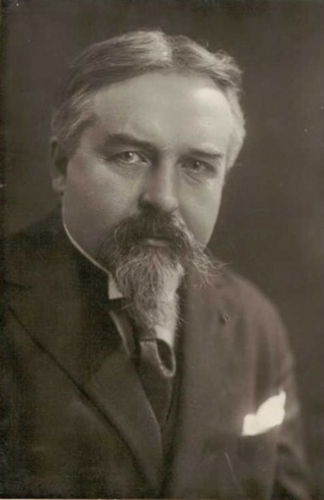
Maurice Denis (1870–1943) was a French painter, decorator, writer, and theorist, a major figure of Symbolism, and a founding member of the Nabi group. Through both his works and his writings, he played a key role in the emergence of modern painting, emphasizing the primacy of surface, color, and decorative composition over naturalistic illusion.
Born on November 25, 1870, in Granville (Manche) and raised in Saint-Germain-en-Laye, where he lived for most of his life, Denis discovered his artistic vocation early. In 1888, he entered the Académie Julian in Paris, where he met Paul Sérusier, who introduced him to the principles of Synthetism derived from Paul Gauguin’s teaching at Pont-Aven. Around these young artists, the Nabi group formed, which also included Pierre Bonnard and Édouard Vuillard. Surnamed the “Nabi of beautiful icons,” Denis became the group’s principal theorist.
In 1893, he married Marthe Meurier, who became a central figure in his pictorial universe. Intimate family scenes, depictions of motherhood, and female figures in serene landscapes reflect the importance of the domestic sphere as a source of inspiration. As the father of several children, he drew continuously on his family life as a source of subjects imbued with gentleness and spirituality. After Marthe’s death in 1919, he remarried in 1922 to Elisabeth (Lisbeth) Graterolle and continued his work at the “Prieuré” in Saint-Germain-en-Laye, now a museum dedicated to his art.
As early as 1890, in his seminal article “Définition du néo-traditionnisme”, he stated that a painting is above all “a flat surface covered with colors assembled in a certain order.” This statement marked a decisive break, establishing an autonomous conception of painting that would influence Fauvism, Cubism, and Abstraction. His production of the 1890s is characterized by flat areas of color, synthetic outlines, and decorative stylization, blending Symbolism and spirituality. Inspired by medieval art and the early Italian Renaissance, notably Fra Angelico, he sought to reconcile formal modernity with spiritual tradition.
Alongside his easel paintings, Maurice Denis developed an ambitious decorative oeuvre. Faithful to the Nabi ideal of integrating art into architecture, he executed numerous monumental projects, both secular and religious, in France and abroad. Religious themes, family scenes, and landscapes of Italy or Brittany structure a body of work in which the human figure occupies a central place, treated with sobriety and harmony.
From the 1910s onwards, his style evolved toward a renewed classicism while maintaining his synthetic principles. In 1912, he published Théories 1890-1910. Du symbolisme et de Gauguin vers un nouvel ordre classique (Theories 1890-1910: From Symbolism and Gauguin to a New Classical Order), a synthesis of his aesthetic thinking. Deeply committed to the revival of sacred art, he founded the Ateliers d’Art Sacré in 1919 with George Desvallières, affirming his desire to reconnect contemporary creation with a living Christian tradition.
Elected to the Académie des Beaux-Arts in 1932, Maurice Denis remained, until his death in Paris in 1943, a central figure of the French art scene. A perceptive theorist and a painter of remarkable coherence, he left a substantial body of work situated at the crossroads of Symbolism, decorative art, and modernized Classicism, leaving a lasting mark on the history of 20th-century art.
