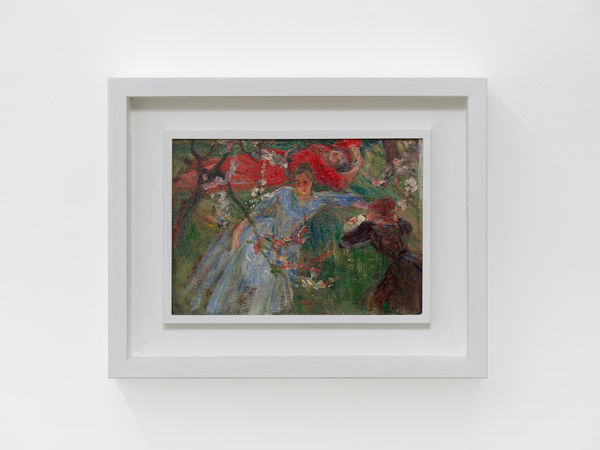
She married the painter and engraver Félix Bracquemond in 1869, whose influence proved ambivalent: while he initially supported her, he later opposed her painting, although Marie Bracquemond joined the Impressionist movement in 1870.
Supported by figures such as Edgar Degas and Claude Monet, she took part in several Impressionist exhibitions (1879, 1880), including the group's last major exhibition in 1886, at Degas's invitation, where she exhibited outstanding works alongside those of Monet, Sisley and Gauguin.
Marie Bracquemond's paintings bear witness to a luminous and vibrant sensibility. In works such as Sur la terrasse de La Chabanne, L'escalier and Parterre de fleurs dans un jardin, she explores the effects of natural light, like her contemporaries Monet and Renoir, but with a gentle personal touch; while her landscapes exude a harmony reminiscent of Alfred Sisley.
In Paysage aux arbres au soleil couchant, she produced a veritable serial study of trees, repeating the same motif at different times of the day and capturing the chromatic changes in the light, confirming Gustave Geffroy's statement that ‘her favourite master was always Claude Monet, about whom she never ceased to speak enthusiastically’.
Her portraits, such as the one of her son Pierre in the Musée d'Orsay in Paris or Trois femmes étendues sur la pelouse, evoke the elegance of Mary Cassatt's work.
Marginalised during her lifetime because of the patriarchal norms of her time, her gradual withdrawal from the artistic scene and her exile, Marie Bracquemond, a symbol of resilience, is today recognised as a pioneer of the Impressionist movement, alongside Berthe Morisot and Mary Cassat, thanks to recent exhibitions in Frankfurt, San Francisco, at the Musée d'Orsay in Paris and in 2024 at the Van Gogh Museum in Amsterdam.
Within the exhibition Shadows and Lights, contemporary artist Thu-Van Tran (1979-) brings a complementary perspective. Born in Ho Chi Minh City, Vietnam, and living in Paris, Thu-Van Tran explores notions of memory, displacement and imprint, often drawing on her personal history and the colonial context of her natal country.
Marie Bracquemond and Thu-Van Tran, although separated by more than a century, share an artistic approach deeply rooted in their personal experiences and their relationship with nature.
As a woman Impressionist, Bracquemond had to draw on her intimate history and resilience to overcome the obstacles imposed by a patriarchal society and a male-dominated artistic sphere. Her paintings not only capture the play of light, but also reflect a quest for harmony with the natural world.
Thu-Van Tran explores collective and personal memory in a context marked by colonial history and environmental change. Her sculpture Novel Without a Title, representing a bronze leaf that is both fragile and perennial, establishes a dialogue with Bracquemond's luminous landscapes.
In their respective works, nature becomes a place of enchantment, a resource that is both material and spiritual, where personal mythologies are reinvented. Thu-Van Tran evokes a ‘sovereign, enchanting nature’, capable of transcending the upheavals of the modern world and nurturing imaginary worlds of renewal.
These two artists, each in their own way, find in nature a mirror of their own condition and a key to writing their way of being in the world. They reaffirm the symbolic power of nature, not only as a source of artistic inspiration, but also as a space for resilience and reinvention of the self, from Impressionism to contemporary art.


-
 MARIE BRACQUEMOND, L'escalier, Circa 1874-1885
 -
MARIE BRACQUEMOND, Parterre de fleurs dans un jardin, c. 1880-1890
-
MARIE BRACQUEMOND, Paysage aux arbres au soleil couchant, Circa 1890-1895
-
MARIE BRACQUEMOND, Sur la terrasse de la Chabane, c. 1870-1885
-
MARIE BRACQUEMOND, Trois femmes étendues sur la pelouse, c. 1875-1885
-
Thu-Van Tran, Novel Without A Title #8, 2020