Far removed from the spiritual and mythological themes dear to her father, but also from the great avant-gardes of her time, such as Surrealism, from which she kept a distance, despite being close to the artists of her time, Madeleine Dinès embarked on a more realistic exploration of everyday life, while infusing her works with a strange poetry, a disturbing strangeness.
From still lifes to self-portraits, from country landscapes to interior scenes, she subtly explores the many facets of a daily life imbued with mystery and melancholy, where each element seems to carry a personal story.
Her interiors, sometimes deserted, preserve the memory of a human presence that has just left the room. In Le lit défait aux pantoufles rouges, the trace of the occupant can be seen in the imprint left on the pillow, the crumpled sheets and the abandoned slippers. Similarly, in Le lit vide, the discarded pillow and the raised blanket suggest a fleeting absence. As for La cheminée blanche, it depicts a strange tranquillity, where objects such as vegetables freshly placed in front of the hearth or an abandoned frying pan evoke a silence fraught with meaning.
Another recurring motif is the figure of a naked person, often the artist herself, immersed in silent introspection, gazing melancholically out of an open window or contemplating herself in a mirror, as in Couple nu au miroir, sur papier peint fleuri. These snapshots of everyday life reflect a deep exploration of existence. This same approach can be found in the various portraits she creates of people close to her, such as Jean Follain or Alain Cuny, or anonymous people she meets while travelling.
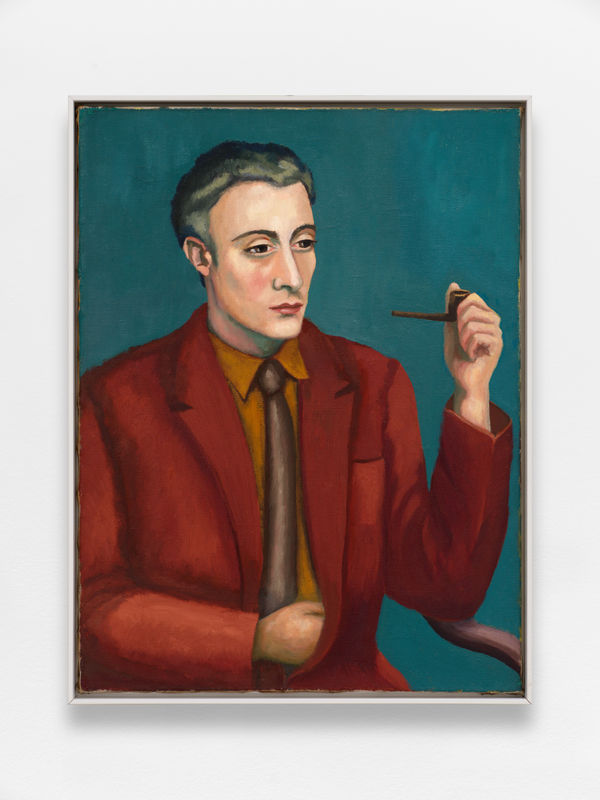
Dinès succeeds in capturing moments when his subjects seem to be absorbed in their own thoughts, as in Portrait d'homme à la pipe.
Her still lifes transform the ordinary into enigmatic scenes, where the innocence of the objects mingles with a disturbing atmosphere. Some of her landscapes, in which strange symbols flourish, border on the Surrealism.


-
 MADELEINE DINÈSLe lit défait aux pantoufles rouges, Circa 1930Huile sur toile
Oil on canvas64,7 x 100,5 cm
25 1/2 x 39 5/8 inCourtesy of Pavec -
MADELEINE DINÈSRideau vert, c. 1930Huile sur isorel
Oil on plywood35 x 27 cm
13 3/4 x 10 5/8 inCourtesy of Pavec -
MADELEINE DINÈSCheminée blanche, c. 1930Huile sur toile
Oil on canvas65 x 50.3 cm
25 5/8 x 19 3/4 inCourtesy of Pavec -
MADELEINE DINÈSPortrait d’homme à la pipe, c. 1940Huile sur toile
Oil on canvas61 x 46 cm
24 x 18 1/8 inCourtesy of Pavec -
MADELEINE DINÈSNature morte aux moules / Pots de cyclamens, Circa 1940Huile sur toile
Oil on canvas35,2 x 45 cm
13 7/8 x 17 3/4 inCourtesy of Pavec -
MADELEINE DINÈSPortrait d’homme (Alain Cuny), c. 1940Huile sur carton
Oil on cardboard45,3 x 33,4 cm
17 7/8 x 13 1/8 inCourtesy of Pavec -
MADELEINE DINÈSReflet de nu à la fenêtre dans un miroir, c. 1930Huile sur toile
Oil on canvas55 x 46 cm
21 5/8 x 18 1/8 inCourtesy of Pavec -
MADELEINE DINÈSLe billard, c. 1950Huile sur toile
Oil on canvas65 x 81 cm
25 5/8 x 31 7/8 inCourtesy of Pavec -
MADELEINE DINÈSBouquet aux épis de blés et feuillages, c. 1950Huile sur isorel
Oil on plywood46 x 38,2 cm
18 1/8 x 15 inCourtesy of Pavec