BLUE PRINT: MATHILDE DENIZE

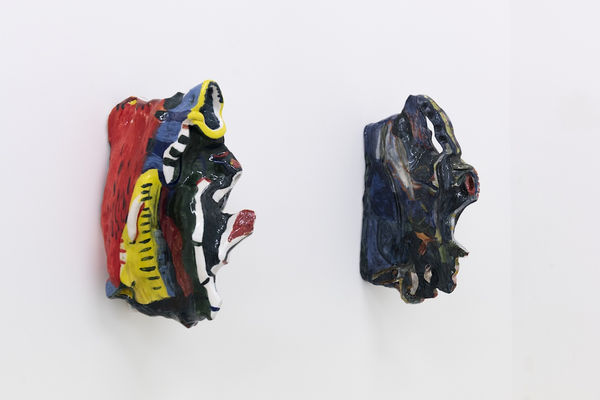
MATHILDE DENIZE, Form with mind, 2017
Because I paint I sculpt, no because I sculpt I paint, no, because I paint I sculpt, I can’t figure because I paint, I can figure because I sculpt, no I figure because I sculpt, I can’t figure with my paint, because I sculpt, I can figure because I’m paint, because I sculpt, no, because i’m paint.
We could dare to extract mysticism from ordinary life. It would be like a ritual, standing in front of Mathilde Denize's objects where there is no truth to be sought, and imagining oneself taking on the role of an archaeologist probing the present and trying to detect fragments, witnesses of an elusive totality. Although she draws on the everyday, there is no appropriation of reality, but rather an embodiment of memory and attention to the sensitive in the form revealed by assemblages and reminiscences.
Blue Print - usually on a white background - is a technique used for architectural plans and
industrial drawings that reproduce the standards of the object to be examined from every angle, in order to project its representation into space. Mathilde Denize has no drawings, no standards to model, but rather immaterial imprints, (blue) thoughts whose trajectory escapes all fixity. Even if it is volatile, what can be grasped in extremis from oblivion traces a poetics of form, and touches on an economy of gesture that we perceive as the unfolding of a modest attitude. The gesture follows an intuitive choreography, oscillating skilfully between painting and sculpture, and interfering exactly there, in the in-between where the object is born. If the relationship with the medium is intensified in this interstice, it should be noted that the painting does not cover the form but constructs its spatiality and invests the field of representation of the object in the exhibition space. The Pauline Pavec gallery then becomes the place where the work is staged. The glazed ceramic assemblages reveal thoughts that take on the enigmatic form of dreams, and are charged with a memorial dimension. The removal of any semblance of grandiloquence brings the work closer to the intimate, so that something sacred remains in these domestic ex-votos, maintaining a spontaneous pact with the viewer. Some of the sculptures, with their organic allure, stand out majestically against their geometric base, acting as a clue to the sacred form. Each is a variation in thought, a transformation of the fragment through gesture,
temporality and materials. We could almost end up talking about painting without a canvas, yet Mathilde Denize has carved costumes in bas-reliefs from her own scraps. Previous attempts at figuring on the stretcher have ended in their disappearance, but this has not been a definitive gesture.
Transmuted, the cut-out canvases sculpt a presence of the body, of the figure, hollowed out by its absence. Mathilde Denize sets the scene for a body of work in which painting and sculpture become entangled, willingly affecting each other's identities in constant movement. Each piece responds to an approach in which they combine with each other to generate an interaction with real space that can be found in Ree Morton, one of her inspirations, about whom Lucy Lippard distinguished a controlled space, always dispersed but no less captured between the pictorial and the sculptural.[1].
Faced with the passing world, Mathilde Denize takes samples of existence, modelling immediate impressions in which the abstraction of any context prefigures an intuitive language. By taking hold of what is a priori insignificant, upside down and discreet, she gives form a magical quality, brushing up against the edges of reality. Shaped by the imaginary, what resists in the territories of the mind joins the tangible and accesses an uncertain, if not fleeting, part of reality, always full of freedom.
— Fiona Vilmer