FEUILLES MORTES: JACQUES PRÉVERT
Past exhibition
Overview
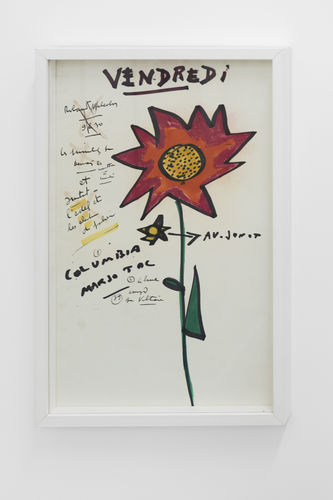
JACQUES PRÉVERT, Ephémérides, 1950-1960
« Jacques Prévert est l’ami intime des fleurs vivantes. », Henri Matisse 1948.
"Jacques Prévert is the intimate friend of living flowers", Henri Matisse 1948.
Jacques Prévert was born on 4 February 1900. From an early age he was interested in artists, discovering the Impressionists and Van Gogh's "red so red", which moved him. In the 1920s, at 54 rue du Château in Montparnasse, he became "the one with the red heart 2", inventing the term "cadavre exquis" as a founding member of Surrealism, alongside Yves Tanguy, Marcel Duhamel, Alberto Giacometti and Max Ernst. Prévert began writing and went on to write scripts and dialogues for some of the great French films of 1935-1945: Marcel Carné's "Le Quai des brumes", "Les Enfants du paradis" and "Les Portes de la nuit", and Jean Renoir's "Le Crime de Monsieur Lange".
The link between Jacques Prévert and the arts is undeniable; it can be seen in his works and texts, between poetry and art criticism. As early as 1939, in Saint-Paul-de-Vence, Jacques Prévert befriended Picasso, Chagall, Braque, Miro, Bonnard, Calder and Matisse, all of them surrounded by the Maeght family and more confidential artists of art brut. Later, Prévert rubbed shoulders with certain members of Cobra, such as Asger Jorn, and Figuration Narrative.
Alongside his writing, song lyrics, dialogues and poetry, Jacques Prévert developed a large and remarkable body of visual work: collages, drawings, illustrated manuscripts, sketches for screenplays and Ephémérides.
Alongside his writing, song lyrics, dialogues and poetry, Jacques Prévert developed a large and remarkable body of visual work: collages, drawings, illustrated manuscripts, sketches for screenplays and Ephémérides.
At the end of the 1950s, when he moved to Cité Véron with Boris Vian, he set up a highly unusual protocol: the Ephémérides enluminées. Using them as a diary, he wrote down his schedule, his appointments and a few thoughts. Influenced by his artistic encounters, particularly with Picasso and Miro, he adorned his sheets with a powerful palette of colours, with flowers, all different, painted with felt-tip pens, pastels and coloured pencils. With their gentle repetition, the Ephemerides are a delicate, joyful work that reveals all the originality of its author. They are images of the passage of time, each Ephemeris turning a flower and a set of appointments into a unique day.
Jacques Prévert, behind this series full of candour, is not foreshadowing the formal and conceptual works of the 1960s - such as those by On Kawara - or one of the fundamental issues of art in the second half of the twentieth century: the desire to link art and life.
Jacques Prévert, behind this series full of candour, is not foreshadowing the formal and conceptual works of the 1960s - such as those by On Kawara - or one of the fundamental issues of art in the second half of the twentieth century: the desire to link art and life.
Installation Views


Works
-

JACQUES PRÉVERT, Ephémérides, 1950-1960
-
JACQUES PRÉVERT, Ephémérides, 1950-1960
-
JACQUES PRÉVERT, Ephémérides, 1950-1960
-
JACQUES PRÉVERT, Ephémérides, 1950-1960
-
JACQUES PRÉVERT, Ephémérides, 1950-1960
-
JACQUES PRÉVERT, Ephémérides, 1950-1960
-
JACQUES PRÉVERT, Ephémérides, 1950-1960
-
-
JACQUES PRÉVERT, Ephémérides, 1950-1960


Video
