Introduction: A Documented Absence
The catalogue of the International Surrealist Exhibition, held at the New Burlington Galleries, London, from 11 June to 4 July 1936, is a piece of remarkable cultural weight. Printed by the Women's Printing Society Ltd, it documents an exhibition put together by committees from England, France, Belgium, Scandinavia and Spain (International Surrealist Exhibition, 1936). Over 390 works by sixty-eight artists were displayed. The cover was designed by Max Ernst; the preface was written by André Breton; the introduction by Herbert Read. It was, in every sense, the moment at which surrealism announced itself as an international movement to the English-speaking world.
Among the catalogue entries are two names that have largely disappeared from subsequent art-historical accounts of surrealism: Erik OLSON and Stellan MÖRNER. Both were founding members of the Halmstad Group (Halmstadgruppen), the Swedish artist collective formed at the initiative of Stellan Mörner in 1929. The group developed a distinctive form of surrealism throughout the early 1930s. Their presence in London in 1936 is in part thanks to the Danish surrealist Vilhelm Bjerke-Petersen, noted in the exhibition catalogue as the representative of Scandinavia in the exhibition committee.
They had participated in the landmark Kubisme=Surrealisme exhibition in Copenhagen the previous year where Erik Olson was co-organiser. Erik Olson was personally known to Breton, who named him in print as early as 1935; Stellan Mörner's connection to Breton's circle was, by contrast, mediated by the collective networks and exhibitions discussed below rather than by documented personal acquaintance. Both, in different ways, were part of the network through which international surrealism organised itself in the mid-1930s.
That these artists are the subject of no more than a handful of academic articles in English is itself a historical fact requiring explanation. The present article undertakes three related tasks. First, it reconstructs the networks and circumstances through which Olson and Mörner came to be included in the 1936 London exhibition, drawing on the available published record and on direct consultation of Swedish museum collections and catalogues. Second, and central to its argument, it examines specific works by the group (exhibited in 1936 and others) to characterise the distinctive contribution of Swedish surrealism to the international movement. The aim is to emphasise the place of these surrealist artists as colleagues of the other European artists, and not inferior derivatives of their French and Belgian fellow artists, with an art transformed by a different visual and intellectual culture. Third, it situates the persistent absence of this history within the broader failure of surrealism scholarship to account for the Nordic contribution to the movement. The article concludes by identifying the archival resources that future scholarship can engage with.
The Halmstad Group: Birth and Journey to Surrealism, 1929–1935
The Halmstad Group was formed in August 1929, at the initiative of Stellan Mörner, and included six artists from the Swedish coastal city of Halmstad: Erik Olson (1901–1986), Axel Olson (1899–1986), Waldemar Lorentzon (1899–1984), Sven Jonson (1902–1981), Esaias Thorén (1901–1981), and Stellan Mörner (1896–1979). Except for Mörner, a nobleman who had studied art history before training (first as a historian, then as an artist) in Paris, the group's members were artisans and clerks: a carpenter, two decorators, a draughtsman, and a company copier. What united them was an exposure to the Parisian avant-garde and a determination to introduce modernism to a Swedish art scene dominated by national romanticism and naivism (Fuchs, 2019).
The group's education had put them in direct contact with the most significant figures of European modernism. Erik Olson and Waldemar Lorentzon had studied at Fernand Léger's Académie Moderne in 1924, where they befriended Otto G. Carlsund and the Danish artist Franciska Clausen. In May 1927, Olson and Carlsund visited Piet Mondrian in his studio. Axel Olson had studied in Berlin with the Russian sculptor Alexander Archipenko in 1922–23. Mörner, arrived in Paris in 1923 nominally to research a monograph on the eighteenth-century painter Taraval, but instead enrolled at the Académie de la Grande Chaumière, and encountered Breton's first Surrealist Manifesto the following year. He later returned to Sweden. All Halmstad Group artists kept correspondence, but Surrealism, however, did not appear in the Halmstad Group artists’ works until the early 1930s (Halmstad Municipality n.d.-a). As for Esaias Thorén and Sven Jonson, they left Halmstad for Stockholm during the early 1930s.
The transition from cubism to surrealism was led above all by Erik Olson, who from Paris maintained an active correspondence with the other group members, describing exhibitions he was attending, works he was encountering, and directions he was exploring. He joined Cercle et Carré in 1930 and Abstraction-Création in 1931, but progressively oriented his practice towards surrealism. By the end of 1930, he had painted Handsken är kastad (The Glove is Thrown), regarded as his first surrealist work and described as 'the Halmstad Group's first surrealist painting'. In 1934, he joined the Paris surrealist group Gravitation and drew Sökaren (The Seeker). Sökaren is a drawing executed in pencil and heightened white on paper (24.5 × 34 cm), dated from 1934 (Figure 1). The work is a horizontal format working of a motif Olson would return to across at least two paintings: Sökaren I and Sökaren II, now held respectively at Moderna Museet and Hallands Konstmuseum.
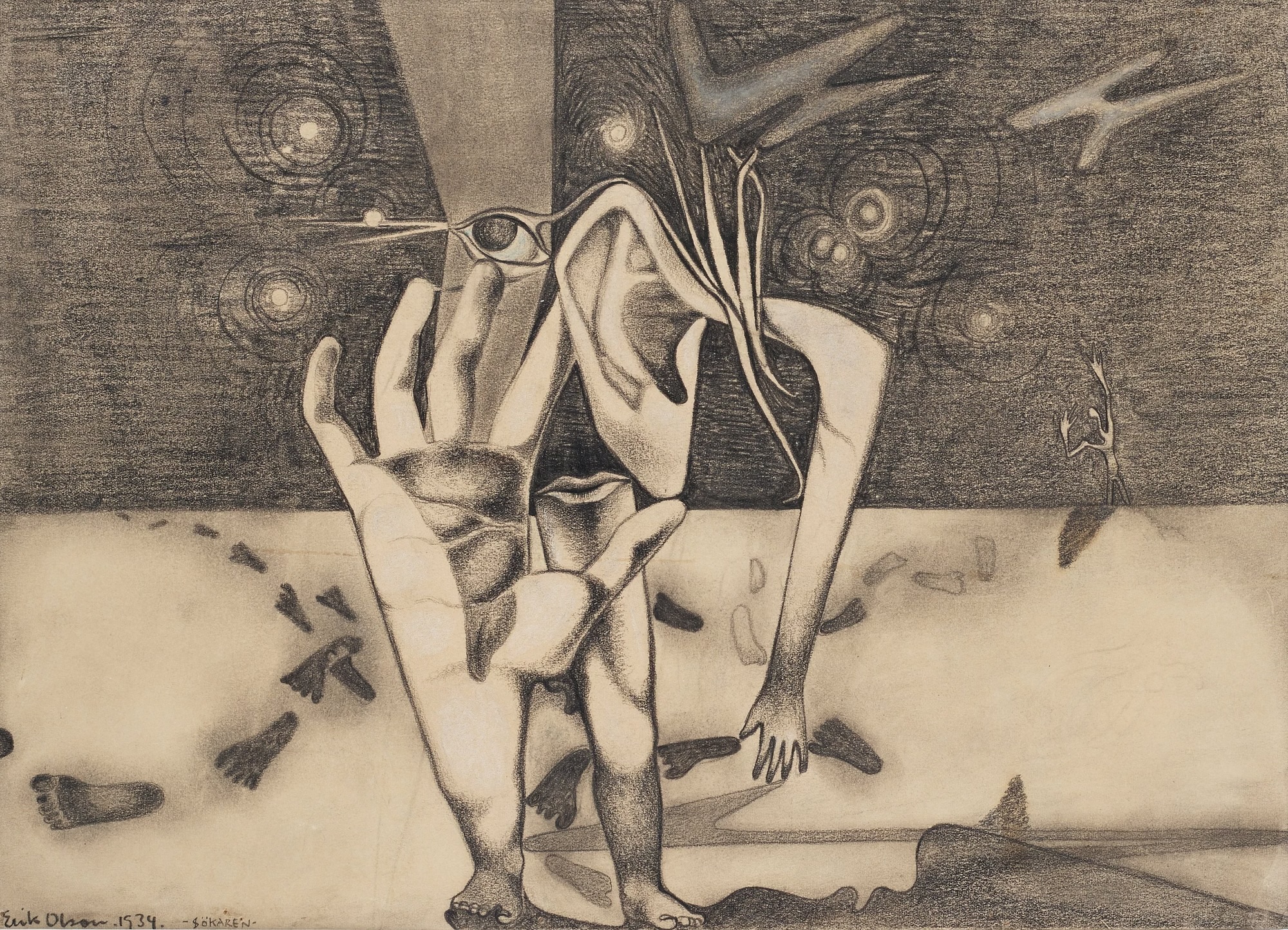
Figure 1: Erik Olson, Sökaren, 1934, pencil on paper, 24.5 x 34 cm
The work represents a character, or rather a figure, that has no face. In its place, individual organs of perception are distributed across the picture plane. We find a single eye, with its gaze marked by lines going into the sky; an ear immediately beside it that turns into a single shoulder, arm and hand; dominating the centre of the sheet, an enormous open hand, fingers spread, holding the ear as if in search of something to hear; the wrist of the hand turns into a single bare leg, standing on the ground; and in between the thumb and index, a mouth, isolated, orphaned from any jaw or cheek, but that seems to be the source top part of thigh, becoming a second leg, that lands on the floor just next to the first. The placement of lips at the top of a thigh, close to where genitals would sit, evokes the erotic charge common in surrealist imagery without being overly sexual or explicit. The two legs are standing straight, side by side. A form of figure hence appears, with no body, and organs displaced.
The horizon line divides the sheet into two halves: a dense, worked, nocturnal upper zone, and a pale lower zone of open land, like a desert. Dart-shaped forms appear in the sky, circled by concentric rings that read alternately as ripples, or orbits add to the mystery of the scene. Are these stars that are radiating something or sending messages? On land, two trails of footprints cross the sand, one of them leading to the standing figure, recording the passage of a search still in progress. At the horizon's edge, far to the right and reduced almost to a hieroglyph, a single slight figure stands with arms raised, without making explicit what the character is signalling or why it’s arms or in the air. Whether it is calling the seeker, or a threat to the figure is undetermined.
The drawing's central device is a figure built entirely from organs of perception, fused into one another rather than distributed as separate parts: ear becomes arm and hand, wrist becomes leg, mouth becomes thigh becomes second leg. No organ stays in place long enough to anchor a stable anatomy, and no face gathers the perceptions into a self. This dissolution of the rational, unified subject, is recognisably surrealist territory but the means are distinctive. The transformation is total and continuous, closer to biomorphic metamorphosis than to Masson's automatism or Miró's invented forms.
Two years before Sökaren, a critic already sensed that the Halmstad’s group's surrealism was not organised around the transgressive, sexually charged content Breton's movement had made scandalous in Paris: "Damn it! If you have something uncomfortable and indecent inside, show it! Now you make proselytes among a meek bourgeoisie! The way you paint, you make Freud feel ashamed of you!" (Hentzel 1932). Sökaren bears this out with some precision: the mouth placed at the top of the thigh gestures toward the erotic charge Hentzel found missing, but stops short of depicting it, the pun stays discreet rather than confrontational. What Hentzel read as a deficiency is better understood as a different register altogether: dreamlike, narrative, and searching rather than transgressive. The footprints crossing the ground supply a temporal, storytelling dimension largely absent from the single arrested instant favoured by Ernst or Magritte, and the hand's grip on the ear, holding it as if straining to hear, makes the act of searching itself, rather than its object, the drawing's real subject.
The tiny figure at the horizon's edge, arms raised, resists easy resolution: it could be calling to the seeker or warning it away, and the drawing supplies no means of deciding between the two. That irresolution is itself characteristic of the group’s work, often mysteries held open. The same is true of the sky, where dart-shaped forms and concentric rings read variously as ripples, orbits, or signals, without settling into any one of them. And the fact that Olson returns to this figure across a drawing, two paintings, and a print series indicates the creation of an authored and developing personal iconography. Sökaren, on this reading, is the point at which the group shifts to a surrealist vocabulary, the specificity of which will be studies later in this article.
A year later, in 1935, Olson held an important solo exhibition of surrealist works in Paris, following which Breton offered personal encouragement (Riksarkivet n.d.). This was a mark of genuine recognition from the movement's own arbiter. Breton's decision to include a Scandinavian committee and have Olson among the invited artists in London for the 1936 International Surrealist Exhibition confirms that Breton was following what the Scandinavian artists were working on and developing in relation to surrealism.
Copenhagen 1935: The Architecture of a Network
Prior to the Halmstad Group's appearance in London in 1936 was their participation in Kubisme=Surrealisme, the international exhibition held at Den Frie Udstillingsbygning, Copenhagen, from 15 to 28 January 1935. The exhibition has been described by the host institution as the first international surrealist exhibition. This claim requires the qualification that the Paris Galerie Pierre show of 1925 has chronological precedence, but Kubisme=Surrealisme was nonetheless the first systematically international group exhibition to be organised explicitly under the banner of surrealism as a movement, and drew a considerably wider geographic base than its Paris predecessors (André Breton Archive n.d.-a ; André Breton Archive n.d.-b)
The exhibition was organised jointly by the Danish artist and theorist Vilhelm Bjerke-Petersen (1909–1957) and Erik Olson (AWARE n.d.). Bjerke-Petersen brought a route into surrealism that diverged markedly from Olson's Parisian formation. Bjerke-Petersen was trained at the Bauhaus under Kandinsky and Klee (1930–31), his theoretical vocabulary was shaped by Bauhaus abstraction and constructivist pedagogy before it turned toward the unconscious. He had nonetheless developed direct correspondence with Breton, Éluard, Penrose, Gascoyne, and Herbert Read, and his 1934 book Symboler i abstrakt kunst had established him as a leading theorist of surrealism in the Nordic countries (Breton and Éluard 1938). Olson brought the Halmstad-Paris / Stockholm-Paris network thanks to his memberships in Parisian avant-garde formations, and his established role as the Halmstad group's international ambassador.
The exhibition was remarkable in its scope. Alongside canonical French surrealists such as Dalí, Ernst, Magritte, Miró, Man Ray, Tanguy, Klee, the exhibition included the Halmstad Group members Sven Jonson, Waldemar Lorentzon, Stellan Mörner, and Axel Olson, as well as the Swedish avant-garde pioneer Gösta Adrian-Nilsson (GAN), who had mentored the founding members of the Halmstad Group. From Denmark, Wilhelm Freddie, Franciska Clausen, Henry Heerup, Rita Kernn-Larsen, and Gustaf Munch-Petersen participated, among others. André Breton's decision to write the preface of the catalogue attests to his endorsement of the exhibition, his awareness of Surrealism's international scope a year before the International Surrealist Exhibition, and his willingness to lend his name to the project and its artists. The preface articulated the explicitly transnational ambition of the surrealist project: the movement, he declared, was no longer purely Parisian, and named Erik Olson specifically among those whose work was radiating its light internationally (Breton 1935, quoted in Paldam 2023).
The personal and organisational consequences of Kubisme=Surrealisme for the path to London in 1936 were direct. The Vilhelm Bjerke-Petersen correspondence archive, a multi-institutional digital research project whose introduction is hosted by the Statens Museum for Kunst, Copenhagen, states that these contacts 'laid the foundation for the Danish surrealists' subsequent participation in the major international surrealist exhibitions in London in 1936 and in Paris in 1938 and 1947' (Bjerke-Petersen Correspondence Archive n.d.). Erik Olson, who co-organised Copenhagen with Bjerke-Petersen, and who by 1935 was himself relocating to Denmark, was embedded in that network. Stellan Mörner, who would also show in London in 1936, was less involved in the organisation, but he and the Halmstad group’s patron Egon Ostlund, were the key spokespeople for the Halmstad Group, regularly interviewed and quoted in relation to the group’s exhibitions, work and projects (Fuchs 2019). His participation in the 1936 London show might result from him being a key figure for Swedish avant-garde and surrealism.
London 1936: Organisation, Selection, and the Scandinavian Presence
In 1935, Roland Penrose (artist and historian) and David Gascoyne (poet) met in Paris, and decided to bring surrealism to Britain. This encounter initiated the project of the International Surrealist Exhibition. A London committee was formed. In parallel, a French committee constituted of Breton, Éluard, Man Ray, and Georges Hugnet, was responsible for selecting non-British artists. Crucially, the exhibition couldn’t simply be a British–French joint venture, and additional committees were created from Belgium, Scandinavia and Spain. The Scandinavian committee was composed of a single artist, Vilhelm Bjerke-Petersen.
By the time of the London exhibition, Erik Olson was settled in the fishing village of Taarbæk near Copenhagen, embedded in the Danish surrealist milieu that included Bjerke-Petersen, Wilhelm Freddie, and Elsa Thoresen. His inclusion in the exhibition must be understood as part of a coordinated, collective Scandinavian presence. This is confirmed most concretely by the existence of a companion publication, The Art of the Surrealist in Denmark and Sweden (Copenhagen: Fischers Forlag, [1936]), published by the Danish and Swedish surrealist groups specifically for the London exhibition. The catalogue, with cover designed by Bjerke-Petersen, contained reproductions of works by Stellan Mörner, Axel Olson, Harry Carlsson, Sven Jonson, and others. It’s cover had titles in English, French and Danish, in this specific order, testify of the desired international reach of the publication. It also demonstrates that the Scandinavian artists were not passive recipients of a Parisian invitation but active and organised participants of an avant-garde, who shaped their own collective presentation to an international public. Three artists would be invited in London, but the publication proves a will to go beyond invitations and actively spread Scandinavian artists’ work abroad.

Figure 2: Erik Olson, Pelaren, 1936, Oil on canvas, 47 x 27 cm
Among the works Olson exhibited in London was Pelaren (The Pillar), a small oil on canvas (47 × 27 cm; 59.5 × 39.5 cm including frame), signed and dated 'Erik Olson · 1936' (Bosson 2009; Bosson 1979; Auctionet n.d.) (Figure 2). The painting stages a female figure, seen from behind, leaning against an architectural pillar whose scrolled capital cradles a cracked egg; the pillar itself is rendered with the soft, fleshy modelling more commonly reserved for the body, so that column and figure become continuous with one another, support and embrace collapsing into a single form. The device recalls the classical fragments and dislocated architecture of de Chirico's metaphysical squares, but Olson's handling is considerably more corporeal and less illusionistically cool: the paint surface lingers on flesh, and warm colors that has no direct equivalent in de Chirico. The cracked egg atop the pillar, a recurring surrealist motif of latent or interrupted birth, sits in evident tension with the pillar's architectural solidity. The graduated background, moving from rose through deep blue to violet, situates the figures against an atmospheric horizon consistent with the coastal light discussed below in relation to the group's broader visual vocabulary.
No comparably documented individual work by Mörner from the London exhibition has yet been identified in the course of this research; with the catalogue not mentioning title of works. In the interim, Mörner's documented practice of the period: castle interiors and dramatic shadows drawn from childhood memories of his family's estate, indicates a register closer to aristocratic memory than to Olson's corporeal architecture, which underscores that the Halmstad Group's surrealism was not uniform but a diverse group with multiple versions of surrealism.

Figure 3: Stellan Mörner, Herrgårdsmiljö, oil on panel, 16 x 22 cm
Stellan Mörner's own route to London reflects a different but complementary trajectory. Primarily Stockholm-based by the mid-1930s, Mörner had maintained close contact with Paris since his training at the Académie de la Grande Chaumière in 1923, and had engaged with Breton's first Surrealist Manifesto as early as 1924. His surrealist paintings of the 1930s drew on the haunted imagery of his aristocratic childhood, giving his canvases a distinctly Northern European quality (Figure 3). These works were known in Paris circles through his participation in Copenhagen, and his selection for London reflects recognition of a formally and philosophically distinctive contribution to the movement.
The exhibition opened at the New Burlington Galleries on 11 June 1936. The opening attracted over 1,150 people, who heard an introductory speech by André Breton. Salvador Dalí attempted to deliver his lecture whilst wearing a deep-sea diver's suit and holding two hounds on a leash; nearly suffocating, he had to be rescued by David Gascoyne, who arrived with a spanner to release the diving helmet (National Galleries of Scotland n.d.; Pollard and Pollard 2018). Breton delivered his lecture Limites non-frontières du Surréalisme on 16 June (National Galleries of Scotland n.d.; Breton 1988–2008). Over its three-week run the exhibition attracted over 23,000 visitors and considerable attention from the British press. The Scandinavian surrealists were officially part of an international movement. But how and why has their contribution been left out of non-swedish and danish scholarship and their work left out of non-scandinavian institutional collections?
A Parallel Surrealism: Landscape, Spirit, and the Question of Belonging
One reason the Halmstad Group has not been easily assimilated into existing surrealism scholarship is that their work does not straightforwardly fit the dominant interpretive models derived from French practice. This formal distance, however, is the exact reason for attending to them. Their surrealism was shaped by environmental, spiritual, and social conditions that distinguished it from the French, Belgian, and Czech variants. It constitutes a genuine and independent contribution to the diversity of surrealist practices.
What distinguishes the Halmstad Group from other European counterparts is subject matter, formal vocabulary, and theoretical grounding. The Halmstad Group's dreamscapes often feature the coastal light and maritime landscapes of the Halland region. (Kollnitz et al. 2024 ; Lalander 1986) We can find representations or colors of the pale Swedish sky, the flat beaches of the west coast, rather than the Mediterranean heat of Dalí's Catalan work or the bourgeois Belgian interiors of Magritte's canvases. This is a different phenomenology of the uncanny. What drew the group to surrealism in the first place was its poetic, narrative and dreamlike possibilities. Where much canonical French and Belgian surrealism produces its convulsive beauty by disrupting the familiar domestic or urban scene, the Halmstad Group's strangeness more often emerges from a landscape that is already, by its nature, vast, impersonal, mysterious and evocating a dreamy nature. (Figure 4)

Figure 4. Waldemar Lorentzon, Morning of peace, 1940, oil on canvas, 104 x 134 cm
This gap between the group's self-understanding and Swedish expectations of what surrealism ought to look like was in fact a recurring source of friction. As early as 1932, the previously mentioned critic Marc Hentzel attacked what he saw as a domesticated, toothless surrealism, demanding that the artists show whatever was "uncomfortable and indecent" inside them rather than "mak[ing] proselytes among a meek bourgeoisie," and accusing them of making "Freud feel ashamed" (Hentzel 1932, quoted in Fuchs 2019). The artists themselves largely accepted, and even cultivated, this distinction rather than resisting it. The group had no wish to provoke anyone, and was uneasy with a definition of surrealism that implied sensation, scandal, psychoanalysis or communism. They pursued a distinct position of their own.
|
|
|
|
Figure 5: Esaias Thoren, Relikter (1939), gouache on paper, 43 x 38 cm |
Figure 6: Esaias Thoren, Red Evening (1936), Oil on panel, 55 x 46 cm |


Looking at vocabulary, the group was internally diverse, within the Halmstad Group as well as with the Danish counterparts. Bjerke-Petersen's Bauhaus formation under Kandinsky and Klee inclined the wider Danish network toward abstraction and constructivist rigour; Olson's work, by contrast, deploys an illusionistic, sometimes nearly hyperrealistic facture applied to bodies and sceneries alike, closer in technique to Dalí's or de Chirico's dream-like paintings than to any constructivist residue. Mörner’s practice stemmed from an aristocratic heritage, often depicting the environment in which he lived and grew up. Esaias Thorén's paintings of the 1930s often recurred to desert-like, depopulated terrains, populated in turn by bleached bones, weathered relics, or skies burning red. The repertoire of motifs would seem, on paper, to promise something apocalyptic. And yet his canvases rarely delivered on that promise. In one work, Relikter (1939) (Figure 5) a scatter of curved, horn-like bones rises from an otherwise bare plain beneath a pale, cloudless sky, less a scene of ruin than a kind of desert still life, precise and strangely calm. In another, a saturated apocalyptic red sky serves as a backdrop to intimacy: two human-bodied, swan-necked figures stand embracing, their necks entwined and beaks nearly touching in a gesture closer to a kiss than a threat, while fragments of classical statuary lie scattered at their feet like archaeological debris. (Figure 6) Even here, where the iconography of catastrophe (ruin, dismemberment, a blood-red sky) is most fully assembled, the picture resolves into tenderness rather than dread. The relics, in short, remain enigmatic without ever tipping into menace. What unites these divergent vocabularies is a shared displacement of the Parisian model onto Nordic material reworked through each artist's own formation and circumstance.
These differences bear directly on a question the article has so far left implicit: in what sense, if any, did the Halmstad Group belong to the surrealist movement inaugurated by Breton in Paris? Participation in officially organised surrealist exhibitions: Copenhagen 1935, London 1936, Paris 1938, is a necessary condition of visibility but not, on its own, a sufficient basis for claims of belonging, membership, or influence in either direction. A more precise account distinguishes at least three registers of connection: personal correspondence and acquaintance with Breton, documented on the evidence assembled here for Olson but not for Mörner; participation in the movement's exhibitions and shared publications, documented for both artists, collectively and individually; and a shared theoretical and formal project, present but substantially transformed in the divergent practices described above. Helene Fuchs (2019) mentions a large variety of interventions, media citations, and occasions on which members of the Halmstad Group or their patron Egon Ostlund explicitly described their work as surrealist. They also often clarified that their theoretical grounding was not abiding to Breton’s manifest, but that their practices were differing on the points mentioned above. They desired to bring their own perspective and enrich surrealism as an international and growing movement.
On this basis, the article proposes that the Halmstad Group's surrealism is neither an exact derivative outpost of the Parisian movement, nor an entirely separate phenomenon that happened to share a name, but could be seen as a part of a broader international current that emerged. It originated in the same exchanges: manifestos read, journeys made, exhibitions jointly organised and jointly published; yet it was substantially reworked through the group's own landscape, social composition, and inherited culture. The group's rhetoric was itself a strategy. They distanced themselves from Danish and Parisian surrealism, even though they knew neither was a unified model. At times they drew on folk-tale imagery to make surrealism feel less foreign and threatening to Swedish audiences. This rhetoric should be read as part of their reworking of surrealism, not as proof that they failed to meet some ‘authentic’ surrealist standard. The Halmstad Group’s dedicated museum, the Mjellby Konstmuseum, holding some 500 works by the group; publications made over decades and a fifty-year exhibiting history running from 1929 to 1979, indicates a movement with its own sustained institutional and artistic life, deserving an integration within the history of surrealism.
After London: The Trajectory of Recognition, 1937–1938
The period between Kubism=Surrealism and the years following the 1936 London exhibition represents 'the pinnacle of the Halmstad Group's surrealism' (Halmstad Municipality n.d.-b). In 1937, the group exhibited approximately seventy paintings at a Nordic Surrealist exhibition in Lund. This was a show of substantial scale that unfortunately produced no published catalogue, contributing to its subsequent invisibility in the historiographical record (Metropolitan Museum of Art 2022; Galerie Bel'Art n.d.-b). In 1938, Erik Olson, Stellan Mörner, and Esaias Thorén participated in the Exposition Internationale du Surréalisme at the Galerie des Beaux-Arts, Paris. The show was the most celebrated of all the interwar surrealist exhibitions, featuring works by sixty artists from fourteen countries, organised by Breton and Éluard with Duchamp as 'générateur-arbitre', Dalí and Ernst as technical advisers, and Man Ray overseeing lighting (André Breton Archive n.d.-d).
The participant list for the 1938 Paris exhibition, documented in the André Breton archive, places Erik Olson and Stellan Mörner alongside Dalí, Duchamp, Ernst, Magritte, Miró, Man Ray, Giacometti, Meret Oppenheim, Remedios Varo, and Toyen. No English-language scholarship has yet examined what works the Swedish artists submitted, how they were displayed, or how they were received by the Parisian press.
The trajectory of recognition is therefore precise: Paris avant-garde formations in the 1920s; official creation of the Halmstad Group at the initiative of Stellan Mörner in 1929; co-organisation of the first Nordic international surrealist exhibition in Copenhagen in 1935, where Breton's preface named Erik Olson among the movement's international pioneers; collective organised participation in the definitive international surrealism exhibition in London in 1936, accompanied by a co-published Scandinavian catalogue; a major group showing in Lund in 1937; and participation in the 1938 Paris Exposition Internationale. The group continued to exhibit together until 1979. This fifty-year span that makes them arguably the longest-lived artist group to have participated in the original surrealist exhibitions of the 1930s. The scholarly neglect of this history does not appear, on the evidence assembled here, to be primarily a matter of absent sources.
The Historiographical Problem: Why the Absence Persists
The most recent and ambitious attempt to correct the Parisian bias of surrealism scholarship — the Surrealism Beyond Borders exhibition and catalogue (Metropolitan Museum of Art / Tate Modern, 2021–22) explicitly positioned itself as a historiographic intervention, proposing a 'rhizomatic' model of surrealist circulation that would move beyond the 'simple linear trajectory of influence' reproduced in canonical accounts (D'Alessandro and Gale 2021, 14–17; Foster 2022; D'Souza 2021). Its scope was genuinely remarkable: nearly three hundred works from forty-five countries, contributions from forty distinguished international scholars, and sustained engagement with the surrealist movements of Colombia, Czechoslovakia, Egypt, Japan, Mexico, the Philippines, Romania, Syria, Thailand, and Turkey.
Yet Sweden seems absent. The Nordic countries, whose artists participated in the very exhibitions that Surrealism Beyond Borders identifies as early models of 'Surrealist exhibition-making' (the 1936 London show is explicitly cited as such) do not appear in the catalogue's remapping of the surrealist world. The exhibition that treats the 1936 London ISE as a canonical moment does not mention the two Swedish artists whose names are printed in that exhibition's catalogue, nor the Scandinavian committee that helped organise it, nor the companion publication that the Nordic groups produced for the occasion.
This omission may reflect a structural feature of the 'global surrealism' paradigm rather than a simple oversight, though the point should be advanced cautiously in the absence of any stated editorial rationale for Sweden's exclusion. The paradigm was designed to recover artists marginalised by colonialism, geographic distance from Paris, and the barriers of non-European languages and art markets. In this framework, the Nordic countries fall between categories: they are neither the canonical centre (France, Belgium) nor the postcolonial periphery whose recovery the paradigm privileges. They occupy a European margin that does not fit the political grammar of 'decolonising' the canon, and risk remaining invisible to an approach that is, on this reading, itself structured by a new set of inclusions and exclusions.
A second argument for the persisting absence, is a lack of documentation and research in non-Swedish languages. The scholarly literature on the Halmstad Group in English is sparse. The foundational monograph, Holmér, Lindegren, and Östlund's Halmstadgruppen (Rabén & Sjögren, 1947), remains in Swedish (Holmér, Lindegren, and Östlund 1947). The Brill anthology A Cultural History of the Avant-Garde in the Nordic Countries 1925–1950 (2019) contains a chapter on the group's reception, framed in national terms rather than as a contribution to transnational surrealism history. The Mjellby Konstmuseum has recently published a catalog Halmstad Group: Pioneers of Swedish Surrealism in both Swedish and English. Other substantive current scholarly engagement is represented by the 'Surrealism in the Nordic Countries' symposium held at Moderna Museet (5–6 May 2023) (Moderna Museet n.d.). Academic articles, research and publications in non-Swedish are emerging, but remain few and one could only recommend to fellow researchers to delve into these artists, their archives and publish their research in multiple languages.
Archives, Evidence, and Future Scholarship
The argument of this article rests on what is documentable from published sources and from direct consultation of the Mjellby and Norrköping collections and catalogues. For the purpose of this research, various archival publications from the 1940s until today (mostly in Swedish) have been acquired at second-hand marketplaces, or auction, as no digital version has been created. There is still a great deal to be explored and studied within all these publications. What remains to be investigated in primary correspondence archives is also substantial and constitutes a clear programme for future research. Three principal archival resources call for systematic engagement.
The Roland Penrose Archive at the National Galleries of Scotland holds one of the most comprehensive documentation of the 1936 London exhibition from the British organisational side: correspondence with artists and collectors, installation photographs, annotated hanging plans, lecture typescripts, and press cuttings (National Galleries of Scotland n.d.). Systematic research in this archive could establish which works specifically Olson and Mörner submitted; how their works were positioned in the hang; whether any correspondence between Penrose, Gascoyne, or the French committee and the Scandinavian participants (or intermediaries such as Egon Östlund) survives; and how the British and French press responded to the Swedish contributions.
The Vilhelm Bjerke-Petersen correspondence archive, a multi-institutional hosted by the Statens Museum for Kunst, Copenhagen, is a promising source for reconstructing the pre-London network. Its published introduction already reveals: Bjerke-Petersen's correspondence with both Penrose and Gascoyne; his letters to Egon Östlund about the Copenhagen exhibition and its aftermath; and a reference to Erik Olson's perspective on intra-Danish disputes. The full archive is understood to contain exchanges with Breton, Éluard, Penrose, Duchamp, Kandinsky, Arp, and the Halmstad Group members. The companion publication The Art of the Surrealist in Denmark and Sweden (Fischers Forlag, [1936]), published for the London exhibition, is also a primary document that has not yet been the subject of thorough study in English scholarship.
The Riksarkivet (Swedish National Archives), and the Mjellby Art Museum in Halmstad (which holds approximately 500 works by the group) whose catalogues and library has consulted directly for this research, constitute the primary Swedish archival base, though their correspondence and manuscript holdings, as distinct from published catalogues, have not been opened for this project. The 2024 reopening of the museum with a new research publication, Halmstadgruppen: Den svenska surrealismens pionjärer (English title: Halmstad Group: Pioneers of Swedish Surrealism) indicates active curatorial engagement with the group's international significance. The catalogue exists in Swedish and English. Further collaboration with Mjellby would be an essential component of any extended archival project. The correspondence-biography En sökares vandring by Viveka Bosson and Jan Torsten Ahlstrand (2001), daughter of Erik Olson and founder of Mjellby, is an important Swedish-language source that draws on material not otherwise published.
Conclusion: Rewriting the Exhibition History
In 1936, Erik Olson and Stellan Mörner stood at the New Burlington Galleries alongside Dalí, Ernst, Magritte, Miró, Picasso, and Man Ray. They were active prior to the exhibition within international surrealist networks, and remained active and involved after the show. The Scandinavian surrealist groups collectively published a companion volume presenting their work to the London public. The Halmstad Group had built its place in international surrealism through a decade of sustained effort. Swedish surrealism grew from exchanges with Parisian surrealist artists and intellectuals, and developed into a distinct practice, both formally and philosophically. Infused with the artists’ own landscapes, social compositions, and inherited culture, the contribution to Surrealism as a movement deserves a place in scholarship, institutions and in the broader history of the movement.
The historiographical absence of this story is plausibly the product of language barriers, the structure of canonical art history, and the particular logic of the 'global surrealism' paradigm, which has decentred Paris without adequately addressing all forms of European peripherality. Correcting this absence requires both archival work and theoretical reframing. The Halmstad Group’s case requires a reconsideration of what belonging to the surrealist movement meant, how scandinavian artists enrich the movement, how networks of recognition operated across national and linguistic boundaries, and what forms of surrealist practice have been systematically occluded by scholarship that declares itself to have moved beyond that canon's geography while retaining its hierarchy.
Erik Olson and Stellan Mörner were present in London, and the surviving work and sources assembled here indicate actively contributed to the development of surrealism as a movement. The task now is to write them back into the histories.
References
André Breton Archive. n.d.-a. "1925, Galerie Pierre." Consulté le 19 août 2026. https://www.andrebreton.fr/fr/event/348451.
André Breton Archive. n.d.-b. "1935, Exposition internationale kubisme=surrealisme, Copenhague." Consulté le 19 août 2026. https://www.andrebreton.fr/en/event/1030580.
André Breton Archive. n.d.-c. "1936, International Exhibition of Surrealism, London." Consulté le 1 avril 2026. https://www.andrebreton.fr/fr/event/306140.
André Breton Archive. n.d.-d. "1938, Exposition internationale du surréalisme, Paris." Consulté le 1 avril 2026. https://www.andrebreton.fr/event/315068.
Auctionet. n.d. "Erik Olson, Pelaren." Consulté le 26 août 2026. https://auctionet.com/sv/events/1003-the-modern-art-sale/110-erik-olson-pelaren.
AWARE (Archives of Women Artists, Research and Exhibitions). n.d. "Three Scandinavian Surrealist Women Artists in Paris." Consulté le 1 avril 2026. https://awarewomenartists.com/en/magazine/trois-artistes-femmes-surrealistes-scandinaves-a-paris/.
Bjerke-Petersen Correspondence Archive. n.d. "Introduction." Statens Museum for Kunst, Copenhague. Consulté le 1 avril 2026. https://bjerke-petersen.ktdk.dk/en/about/introduction.
Bosson, Viveka. 2009. Halmstadgruppen – Ett kraftfält i svensk 1900-talskonst. [Édition complète non vérifiée indépendamment.]
Bosson, Viveca, ed. 1979. Halmstadgruppen 50 år. Halmstad: Stiftelsen Halmstadgruppen.
Bosson, Viveka, et Jan Torsten Ahlstrand. 2001. En sökares vandring: Erik Olsons liv och konst. Halmstad: Mjellby konstgård.
Breton, André. 1935. "Preface." Dans Exposition internationale kubisme=surrealisme. Copenhague: Den Frie Udstillingsbygning.
Breton, André. 1988–2008. Œuvres complètes. Édité par Marguerite Bonnet. 4 vol. Paris: Gallimard / Bibliothèque de la Pléiade.
Breton, André, et Paul Éluard. 1938. Dictionnaire abrégé du surréalisme. Paris: Galerie des Beaux-Arts.
D'Alessandro, Stephanie, et Matthew Gale, éd. 2021. Surrealism Beyond Borders. New York: Metropolitan Museum of Art; New Haven: Yale University Press.
D'Souza, Aruna. 2021. "Surrealism Beyond Borders." 4Columns, octobre 2021. https://www.4columns.org/d-souza-aruna/surrealism-beyond-borders.
Foster, Hal. 2022. "At Tate Modern: 'Surrealism beyond Borders'." London Review of Books 44 (10), 26 mai 2022.
Fuchs, Helene. 2019. "The Reception of the Halmstad Group in the 1930s." Dans A Cultural History of the Avant-Garde in the Nordic Countries 1925–1950, édité par Tania Ørum et Jesper Olsson. Leiden: Brill.
Galerie Bel'Art. n.d.-b. "Vilhelm Bjerke-Petersen." Consulté le 1 avril 2026. https://www.belart.se/artists/vilhelm-bjerke-petersen.
Halmstad Municipality. n.d.-a. "Stellan Mörner." Mjellby Konstmuseum. Consulté le 1 avril 2026.
Halmstad Municipality. n.d.-b. "The Surrealism of the Halmstad Group." Mjellby Konstmuseum. Consulté le 1 avril 2026.
Hentzel, Marc. 1932. "Det." Fönstret, 12 novembre 1932.
Holmér, Folke, Erik Lindegren, et Egon Östlund. 1947. Halmstadgruppen: Waldemar Lorentzon, Axel Olson, Erik Olson, Esaias Thorén, Sven Jonson, Stellan Mörner. Stockholm: Rabén & Sjögren.
Kollnitz, Andrea, Helen Fuchs, Johan Zimsen Kristiansen, and Kristoffer Nohelden. 2024. The Halmstad Group: Pioneers of Swedish Surrealism. Edited by Lena From, Erika Danker, and Karin Ekdahl. Translated by Christine Antaya. Halmstad: Mjellby Art Museum.
Lalander, Folke. 1986. Halmstadgruppens 30-tal. Exhibition catalogue, Norrköpings konstmuseum, 27 September–16 November 1986. Norrköping: Norrköpings konstmuseum.
Melusine-Surrealisme.fr. n.d. "Danemark — expositions surréalistes." Consulté le 1 avril 2026. https://www.melusine-surrealisme.fr/surr-ts-pays/pays/danemark.
Metropolitan Museum of Art. 2022. "Building an Archive of Global Surrealism." MetMuseum Perspectives, mars 2022.
Moderna Museet. n.d. "Nordic Surrealism." Programme de symposium. Consulté le 1 avril 2026.
National Galleries of Scotland. n.d. "From Our Archive: The International Surrealist Exhibition 1936." Consulté le 1 avril 2026.
Ørum, Tania, et Jesper Olsson, éd. 2019. A Cultural History of the Avant-Garde in the Nordic Countries 1925–1950. Leiden: Brill.
Paldam, Camilla Skovbjerg. 2023. "Shock: Vilhelm Bjerke Petersen and His Surrealist Exhibition at Den Frie in 1935." Perspective: Journal of Art History.
Pollard, Justin, et Stephanie Pollard. 2018. "The London International Surrealists Exhibition." History Today 68 (6), juin 2018.
Riksarkivet (Swedish National Archives). n.d. "Erik Artur Olson." Svenskt Biografiskt Lexikon. Consulté le 19 août 2026.
Robbert, Louise, ed. 1989. Halmstadgruppen 60 år: Halmstad–Berlin–Paris–Halmstad. Exhibition catalogue, Liljevalchs konsthall, Stockholm, 7 April–4 June 1989. Stockholm: Liljevalchs konsthall.
The Art of the Surrealist in Denmark and Sweden. [1936]. Copenhague: Fischers Forlag.
The International Surrealist Exhibition. 1936. Catalogue d'exposition. Londres: New Burlington Galleries / Women's Printing Society Ltd. Préface d'André Breton; introduction de Herbert Read.